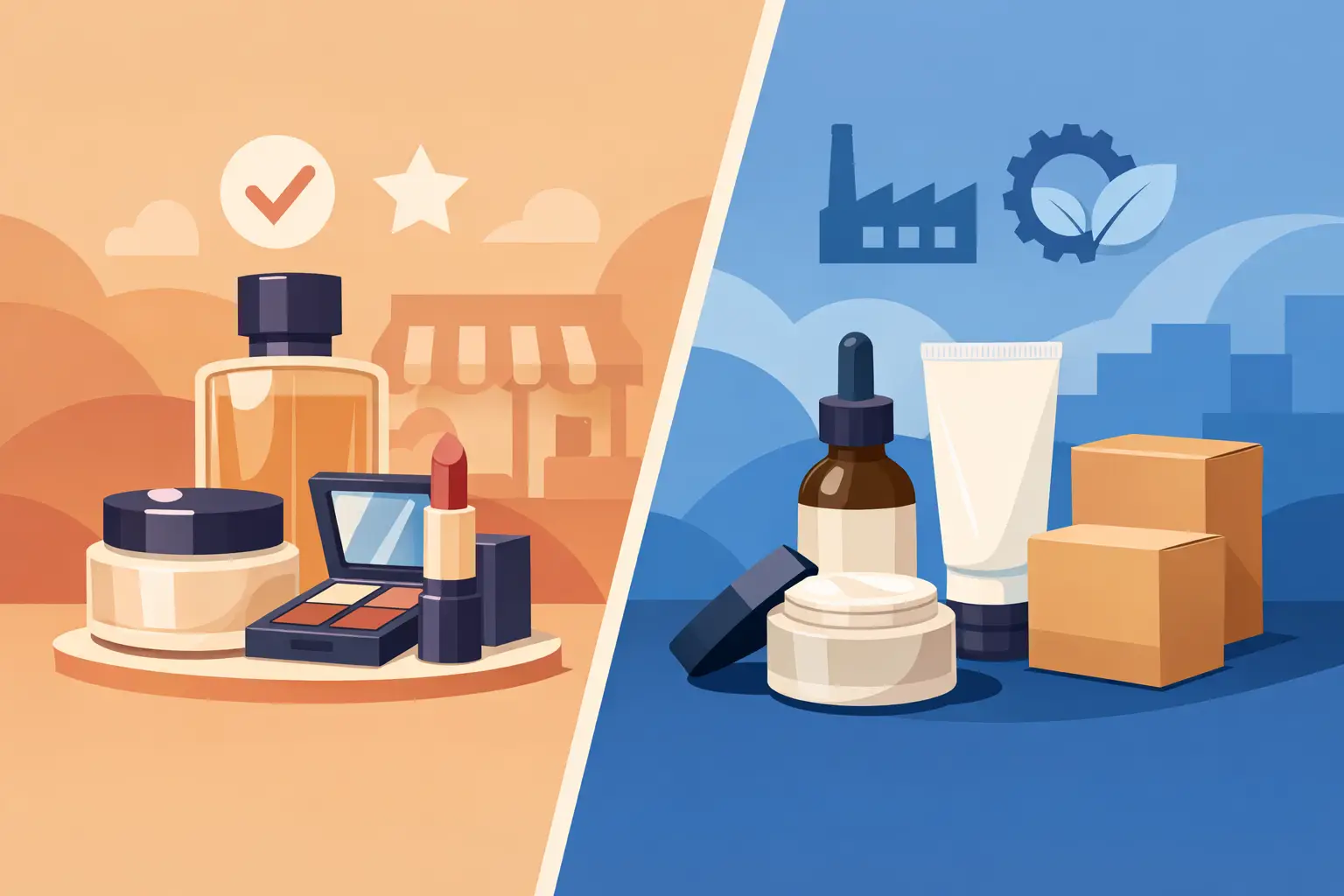
A customer walks into a beauty store looking for a familiar fragrance, a viral lip oil, or the moisturizer they already trust. That moment explains the central question in branded cosmetics vs private label: should retailers prioritize proven names that bring immediate recognition, or build an exclusive range with greater control over price and positioning? The strongest answer is rarely one or the other. It is an assortment decision tied to your customer, channel, cash flow, and growth goals.
For beauty retailers, the difference reaches far beyond the label on the package. It affects how quickly inventory moves, how much capital is tied up in stock, how customers perceive your business, and how easily you can respond to changing demand. A commercially smart range uses each model where it delivers the greatest advantage.
Branded Cosmetics vs Private Label: The Core Difference
Branded cosmetics are products sold under an established beauty brand. The manufacturer or brand owner controls the product identity, formulation, packaging, marketing direction, and often the recommended retail positioning. Retailers purchase recognized perfumes, makeup, skincare, hair care, and personal care products through authorized wholesale channels and sell them to consumers who already know what they are buying.
Private label cosmetics are products produced by a manufacturer and sold under the retailer’s own brand name, or an exclusive brand created for a particular business. The retailer typically has input on packaging, product selection, claims, price architecture, and brand identity. Depending on the program, private label can range from selecting a ready-made formula with custom packaging to developing a product from the ground up.
Neither model is automatically more profitable or more strategic. Established brands can generate traffic and trust on day one. Private label can create differentiation and stronger gross margins over time. The right choice depends on where your business needs certainty and where it can take a calculated risk.
Why Branded Cosmetics Drive Reliable Demand
Recognized beauty brands reduce hesitation at the point of sale. Customers know the scent profile of a favorite perfume, have seen a makeup product on social media, or return for a skincare item that fits their routine. For physical stores, that familiarity encourages walk-ins and repeat purchases. For e-commerce retailers, recognizable products can improve search visibility and conversion because buyers are actively looking for them.
Branded inventory also gives a retailer immediate credibility. A newer beauty store may not yet have its own reputation, but a carefully selected portfolio of trusted brands signals quality, relevance, and product authenticity. This matters especially in prestige fragrance, professional hair care, and treatment-led skincare, where customers often expect proven performance.
From a sourcing perspective, branded cosmetics can be more straightforward when working with a dependable distributor. Product specifications, packaging standards, market demand, and retail references are already established. A wholesale partner such as Glamour TEK AG helps retailers access premium, trend-aware inventory while focusing their energy on merchandising, customer service, and sell-through rather than product development.
The trade-off is control. Retailers generally have limited influence over packaging, promotions, product claims, or wider distribution. A product that performs well for your store may also be sold by competing retailers. Margins can be tighter than on an owned brand, and supply availability may fluctuate when a launch becomes highly sought after or a brand changes its distribution strategy.
Still, tight margins do not mean weak returns. A fast-selling branded product with predictable replenishment can produce healthier cash flow than a high-margin item that sits on the shelf. In beauty retail, sell-through and stock turn are as important as the margin percentage on an individual unit.
Best uses for established beauty brands
Branded cosmetics work particularly well as traffic drivers and confidence builders. They are often the right foundation for retailers that are entering a new category, serving a broad customer base, or selling through marketplaces where shoppers search by brand.
They are also valuable for seasonal gifting. Recognized fragrance and beauty names make purchase decisions easier during holiday periods, when customers often want products that feel premium, familiar, and gift-ready. Retailers can build around known demand while adding smaller trend-led items to increase basket value.
Where Private Label Creates a Strategic Edge
Private label shifts the conversation from selling a brand’s story to building your own. When executed well, it gives retailers a product line customers cannot find at every competitor. That exclusivity can strengthen loyalty, protect pricing, and make your business more memorable.
The margin opportunity is often the most visible benefit. Without paying for the market value of an established brand name, retailers may have more room to set prices that support their financial goals. Private label also lets a business create a clear price ladder, such as accessible everyday essentials alongside premium treatment products.
Control matters, too. A retailer may develop a line around a specific customer need: fragrance-free body care, travel-size beauty essentials, inclusive complexion products, or a tightly edited collection for a particular age group. Packaging, language, bundle formats, and launch timing can align with the store’s identity rather than an outside brand’s calendar.
But private label requires commitment. Product development, packaging approvals, minimum order quantities, quality assurance, compliance documentation, inventory forecasting, and marketing all become the retailer’s responsibility. A compelling formula alone does not guarantee demand. Customers must understand why the product deserves their attention, especially if your brand has limited awareness.
Private label is therefore less forgiving of poor planning. Ordering too broadly, choosing generic products without a clear point of view, or underinvesting in packaging can leave a retailer with slow-moving inventory. The brand may offer higher theoretical margins, but those margins disappear if discounting becomes necessary to clear stock.
When private label is the better fit
Private label is most compelling for retailers with a defined audience and a clear proposition that is not fully served by available brands. It can work well for businesses that have built customer trust, control their own sales channels, and can support a product launch with strong merchandising and repeat communication.
It is also useful when a retailer wants greater insulation from direct price comparison. If the same branded serum is sold across multiple websites, shoppers can quickly compare offers. An exclusive product creates a different buying decision, provided the quality, packaging, and value proposition are credible.
Compare the Commercial Factors Before You Buy
The decision should be made with operating realities in view, not only margin expectations. Branded products usually offer faster demand validation because sales history, social momentum, and consumer awareness already exist. Private label requires validation through your own testing, feedback, and marketing activity.
Minimum order quantities are another dividing line. Wholesale branded cosmetics may allow retailers to test a category or replenish selected bestsellers more flexibly, depending on the supplier and product availability. Private label programs can require larger commitments because packaging and production are customized. That can be efficient at scale but difficult for a business still learning what its customer wants.
Speed to market varies as well. A retailer can often respond quickly to demand by sourcing available branded inventory through an established wholesale partner. Private label development takes longer, particularly when product testing, component sourcing, artwork, and regulatory review are involved. For trend-sensitive categories, a delayed launch can mean arriving after customer interest has moved on.
There is also a reputational consideration. With branded products, the brand owner has already invested in consumer education and product positioning. With private label, the retailer owns every part of the customer experience. If a product disappoints, packaging leaks, or the claims are unclear, the impact lands directly on your business.
Build an Assortment That Uses Both Models
For many retailers, a blended strategy delivers the most practical result. Use recognized branded cosmetics to create trust, attract demand, and maintain dependable replenishment. Then introduce private label selectively where it offers genuine distinction, a clearer customer benefit, or a margin opportunity you can support with inventory discipline.
A fragrance-led retailer, for example, may lead with established perfume brands that customers seek by name. Its exclusive range could focus on travel atomizers, discovery sets, body care, or gifting formats that complement rather than compete directly with the branded assortment. A skincare retailer might use trusted treatment brands as authority builders while developing a simple private-label daily-care line at an accessible price point.
The key is to avoid treating private label as a cheaper substitute for branded products. Customers notice when an assortment lacks coherence. Instead, give each product type a role: branded lines can bring recognition and category authority, while owned products can reinforce your identity and raise the value of the basket.
Make the Decision With Sell-Through in Mind
Before committing to either approach, review what your customers already buy, ask for, and repurchase. Look at category performance by unit sales, gross margin, return rate, and time on shelf. A product with lower margin but consistent reorder behavior may deserve more space than a high-margin item with limited repeat demand.
For private label, begin with a narrow, purposeful launch rather than a large collection. Choose products that solve a clear need and can be explained in one sentence. Test packaging, pricing, and merchandising before expanding. For branded inventory, protect your business by working with suppliers that prioritize authentic products, dependable availability, commercially relevant ranges, and clear communication.
The best beauty assortment is not built around a single sourcing philosophy. It is built around the products customers trust, the opportunities competitors have missed, and the inventory decisions that keep your capital working. Start with the demand you can prove, then use exclusivity where you can make it matter.