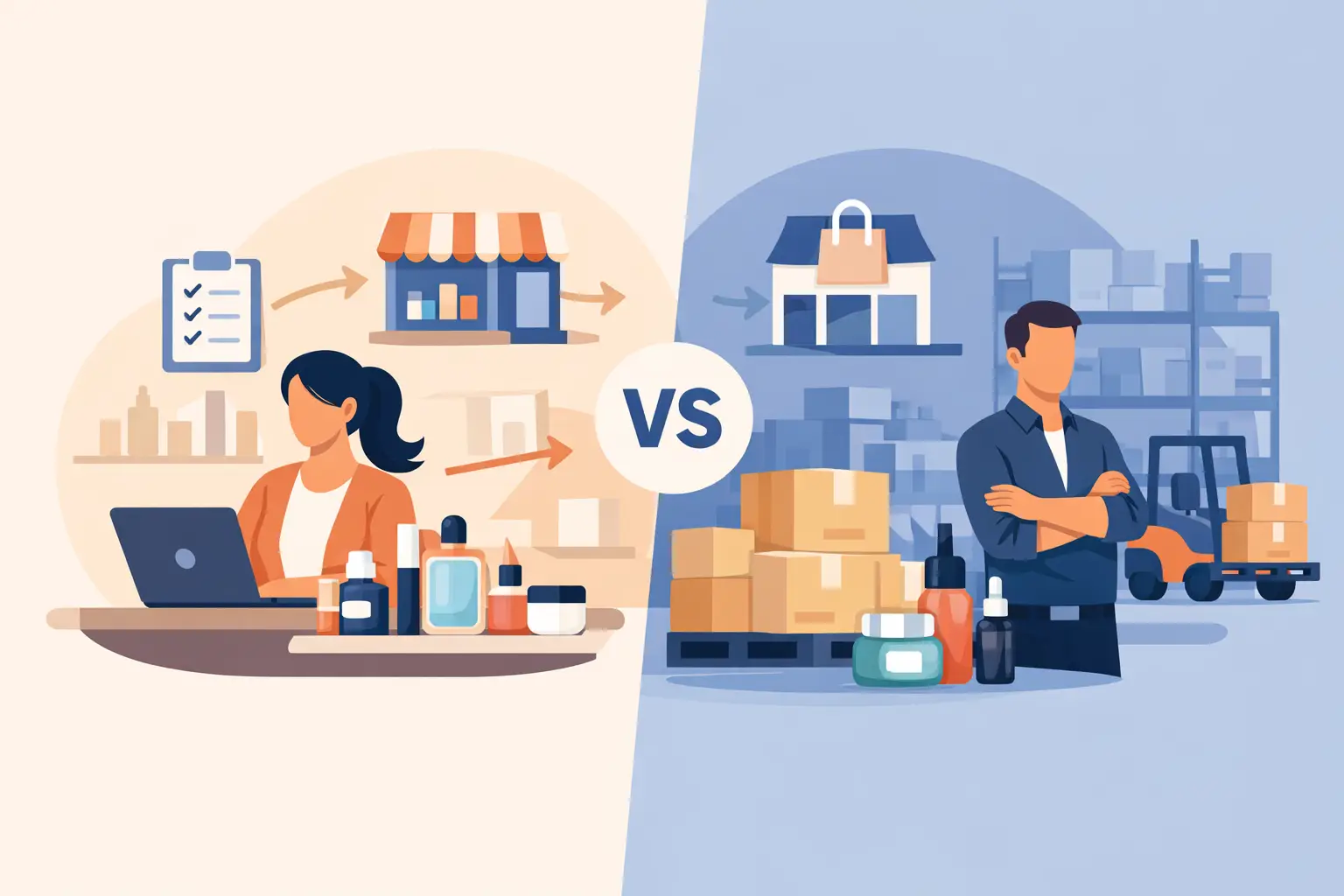
A cosmetics distributor vs wholesaler decision affects far more than your purchase price. It shapes the brands you can access, the consistency of your replenishment, the support behind each order, and ultimately the confidence you have in your beauty assortment. For retailers selling perfume, skin care, makeup, and personal care, choosing the right supply model can be a direct competitive advantage.
The terms are often used interchangeably, and in some cases a supplier performs elements of both roles. The practical difference comes down to how products reach your business, who manages the brand relationship, and what value sits behind the transaction. Understanding that distinction helps you source inventory that sells while protecting margins and reducing avoidable supply friction.
Cosmetics Distributor vs Wholesaler: The Core Difference
A wholesaler buys products in volume and resells them to retailers or other businesses. The wholesaler’s central role is commercial: purchasing inventory at scale, holding stock, and offering it to buyers at a price that leaves room for retail margin. Wholesalers can carry a broad range of brands and categories, making them useful when a buyer wants to consolidate purchasing or test several product lines.
A cosmetics distributor typically has a more structured relationship with the brands it represents. Distributors may be appointed or authorized to bring a brand into a particular market, channel, or customer group. Their work can include market development, product education, launch planning, merchandising guidance, logistics coordination, and ongoing account support.
The distinction is not always absolute. A distributor may sell wholesale to retailers, while a wholesaler may offer strong category knowledge and dependable service. The better question is not which label sounds stronger. It is whether the supplier has the product access, inventory discipline, pricing structure, and commercial understanding your business needs.
What a Cosmetics Wholesaler Typically Delivers
Wholesale is built for efficient buying. A retailer may work with a wholesaler to access established beauty products, replenish fast-moving lines, or create a varied assortment without managing multiple direct supplier relationships. This is especially valuable for independent stores and e-commerce sellers that need breadth without excessive procurement complexity.
A capable wholesaler provides clear product availability, workable order quantities, competitive B2B pricing, and a selection relevant to customer demand. In beauty, this can mean combining dependable everyday items with trend-led products that bring discovery and repeat visits to your store.
Wholesalers are often the practical choice when speed and assortment flexibility matter most. You may need a mixed order across perfumes, makeup, skin care, and personal care instead of committing to one brand’s full catalog. You may also want to respond quickly to a viral category, seasonal gift demand, or a gap in your current range.
That flexibility has trade-offs. Not every wholesaler has direct brand authorization, exclusive territory rights, or the capacity to provide detailed launch support. Product availability can also vary based on market demand and upstream supply. Before buying, retailers should ask direct questions about stock consistency, batch quality, minimum order requirements, and expected replenishment timelines.
What a Cosmetics Distributor Typically Delivers
A distributor’s value often extends beyond moving cartons. Because the distributor may be closer to the brand’s commercial strategy, retailers can gain more structured access to product information, market positioning, and sometimes marketing or merchandising materials. For a newer brand or a specialized category, that support can make a meaningful difference in sell-through.
Distributors may also help protect how a brand is presented in market. This can matter for prestige fragrance, premium skin care, or products with specific usage claims. Buyers receive more than inventory: they receive a clearer framework for how to position the product, who it serves, and how it fits within the wider beauty assortment.
For retailers building a long-term relationship around selected brands, distribution can offer stability and deeper brand alignment. The trade-off may be less assortment freedom, more structured purchasing conditions, or a narrower product portfolio. If your objective is to build authority in a defined category, that structure may be worth it. If your priority is broad, fast-moving inventory across many brands, a wholesale partner may be the more efficient route.
Authorization and product confidence
In cosmetics and fragrance, supply-chain credibility is not a minor detail. Customers expect authentic products, consistent quality, accurate labeling, and packaging that reflects the brand standard. Retailers also need confidence that inventory is suitable for their sales channel and customer base.
An authorized distributor can be particularly valuable where brand control and official market representation are priorities. However, authorization alone does not guarantee the best commercial fit. A retailer should still evaluate pricing, availability, delivery performance, and the supplier’s ability to meet real-world replenishment needs.
Likewise, a wholesaler can be an excellent partner when it demonstrates transparent sourcing, careful inventory handling, and dependable documentation. The key is to verify the supply process rather than relying on the title a supplier uses.
Which Model Supports Better Retail Margins?
Neither distribution nor wholesale automatically produces better margins. Margin depends on your buy price, shipping and handling costs, retail positioning, promotional activity, product velocity, and the risk of holding unsold inventory. A lower unit cost is only valuable if the product moves at a sustainable pace.
A distributor relationship may support stronger margins when it gives you access to differentiated products, better brand storytelling, or a more protected market position. A wholesale relationship may improve margin when it lets you buy proven sellers efficiently, maintain a diverse price architecture, and avoid tying up capital in narrow commitments.
Look beyond the invoice. A slow-selling product purchased at an attractive discount can erode cash flow and consume valuable shelf space. A reliable, high-demand item with a slightly higher cost can produce better returns through repeat purchases and faster inventory turns.
For most retailers, the strongest approach is not choosing one model exclusively. It is building a sourcing strategy that uses each relationship where it adds the most value. A focused distributor partnership can strengthen core brands, while a trusted wholesaler can keep your assortment fresh, flexible, and commercially responsive.
How to Choose the Right Beauty Supply Partner
Start with your business model. A boutique fragrance store, a high-volume online seller, a beauty supply retailer, and a department-store buyer do not need the same kind of supplier. Define what must be true for your next six to twelve months of growth: consistent access to bestsellers, entry into premium categories, broader assortment, lower order thresholds, or faster replenishment.
Then assess the supplier on operating performance, not just product imagery. Ask whether inventory is available now, how often stock is replenished, what happens when demand spikes, and whether the supplier communicates clearly when an item is unavailable. Confirm order minimums, payment terms, shipping capabilities, returns policies, and the product data available for your online listings.
Category expertise matters as well. Beauty trends move quickly, but trend relevance should not come at the expense of commercial discipline. The right partner understands the difference between a short-lived social media moment and a category with lasting customer demand. They can help you balance recognizable staples with newness that gives customers a reason to return.
Finally, consider how easy the supplier is to grow with. As order volume increases, you need a partner that can maintain quality, accuracy, and service. Glamour TEK AG works from this premise: premium, commercially viable beauty inventory should be backed by reliable wholesale execution, not left to chance.
Build an Assortment That Can Perform
The best supplier relationship supports a stronger retail decision at every stage, from initial product selection to repeat ordering. If you need brand depth, category education, and market structure, a distributor may be the better fit. If you need broad access, purchasing flexibility, and efficient replenishment across multiple beauty categories, a wholesaler may be the right choice.
For many growing retailers, the winning move is to evaluate suppliers by the outcomes they create: authentic products, dependable availability, healthy inventory turns, and an assortment customers are ready to buy. Choose the partner that helps your business stay relevant, stocked, and prepared for the next opportunity.